
 Human Quest · Personal growthLog in
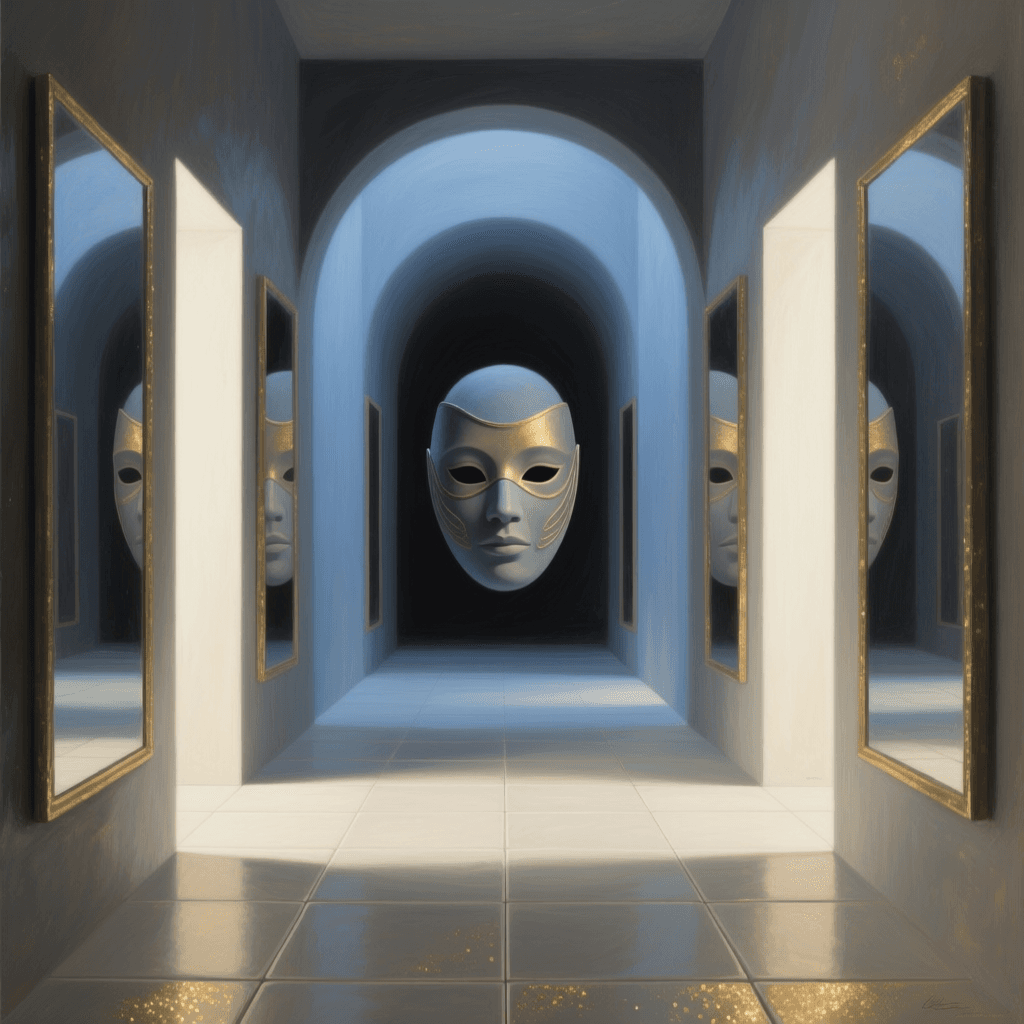
The Persona: The Mask You Forgot You're Wearing
Watch yourself answer the phone for a stranger. Your voice climbs half a register, warms up, rounds off its edges. Now watch it drop back to flat when you realize it was a wrong number. That small, automatic shift is the persona at work — the face you put on to meet the world, so reflexive you barely notice you reach for it.
On Leela Quest's Jungian board, this is square 5, sitting early in the climb where the newborn wholeness of the first squares starts to specialize into a workable social self. The board calls it, simply, The Persona. It arrives right after Belonging (square 4), and that order is the whole point: you build the mask precisely because you learned there was a price for being fully, rawly yourself in front of the group.
Where the word comes from
The persona in Jung's vocabulary borrows its name from the theater. Persona was the mask a classical actor held up to signal which character he was playing — and, by most accounts, to project his voice out to the back rows. Jung took that image and turned it inward. The persona, he suggested, is the role you play to get through the day: the competent professional, the easygoing friend, the reliable parent, the good student. It is the negotiated surface between your private interior and the demands of a world that runs on roles and reputations.
Crucially, Jung did not treat this as a character flaw. He described the persona as a kind of compromise — one struck between the individual and society about what a person will appear to be. You need it the way you need clothing. Nobody walks into a job interview and empties out their full inner weather; nobody should. A working persona lets you function, cooperate, and keep your raw depths to yourself until you choose to share them.
The square's own text puts it plainly: the persona is "a necessary skin. Without it you would be defenseless, unable to function in a world that rewards roles and reputations." The trouble is never that you have one. The trouble is forgetting you're wearing it.
Why the mask is worth keeping
There's a version of self-help that treats any mask as a betrayal of the "authentic self," as though total, unfiltered exposure were the goal. Jung would have found that naive. A person with no persona at all is not enlightened; they're unbearable — and unprotected. The skin exists for a reason.
Consider what a healthy persona actually does for you:
- It regulates distance, so you can be professional with a client and tender with a partner without those two registers bleeding into each other.
- It buys you privacy, keeping your unformed thoughts and tender wounds off the open market until you decide who has earned them.
- It smooths cooperation, letting strangers coordinate on shared roles instead of renegotiating their whole identity every time they meet.
The goal, then, is not to smash the mask but to hold it consciously — to wear it the way you wear a coat, chosen for the occasion and hung by the door when you come home. That last part is where most of us struggle. The coat gets easier to put on than to take off.
When the mask fuses to the face
The danger the square names is over-identification: the slow fusion where you stop having a persona and start being it. Notice how the board sequences it. A few squares later you reach The Polished Surface (square 9), where "the world responds with approval, and approval is intoxicating." Every time the performance earns applause, the mask grows a little more load-bearing and a little harder to remove. Success at the level of persona is a real thing — and it can quietly become a trap, because the better the act, the more terrifying it feels to ever let it slip.
The cost shows up at the moments the role is threatened. When a job ends, a marriage fails, a title is stripped away, someone who was fused to their persona doesn't just grieve a loss — they experience something closer to annihilation. As the square says, "a lost job or failed marriage feels like death, because you mistook the costume for the soul." That disproportion is the tell. If losing the role feels like losing your existence, the mask has been standing in for a self you never quite met.
There's a subtler cost, too, and the board flags it two squares on at Pleasing the Other (square 8): the more fluently you perform acceptability, the fainter your own knowing becomes. You can lose track of what you actually feel, want, or believe, because those truths were never as useful to the performance as harmony was. A brilliant persona and a starved inner life often grow on the same person.
The persona and everything under it
Here's why square 5 matters for the whole Jungian path rather than just its own moment. Every part you tuck behind the mask to keep belonging doesn't evaporate. It goes underground and becomes raw material for the shadow — the disowned self you'll have to meet later on the board. The persona and the shadow are two sides of one bargain: what you show and what you hide are cut from the same original whole.
This is exactly why the work of individuation can't skip either one. The mask has to be recognized as a mask before you can turn and face what it's been concealing. If you want the wider map of that descent, The Jungian Path: Individuation as a Game lays out the full route from persona to Self. And when you're ready to meet what the persona has been keeping out of sight, What Is Shadow Work? A Beginner's Guide and Meeting the Shadow pick up precisely where this square leaves off.
A small practice
You don't dismantle the persona; you get honest about it. Try this over a single ordinary day. Each time you notice your manner shift — the phone voice, the meeting posture, the family-dinner self — silently name the role you just stepped into. This is Reliable Colleague. This is Easygoing Friend. Don't judge it. Just register that a mask went on.
Then, at the end of the day, ask one question: which of these did I take off, and which one came home with me? The mask you can't remove is the one worth watching. That's not a call to tear it away — it's an invitation to remember that a living self stands behind it, the one, in the square's words, "the world has never seen."
Naming the mask is the first move of the whole game. The player who knows he's wearing a persona is already freer than the one who thinks it's his face.
Square 5 is only the beginning of the Jungian climb — the same map runs all the way down to the shadow, the soul-image, and the Self at the goal. Play the Jungian board to walk it square by square, or start a game and let the dice decide where your own reflection begins.
Keep reading
Which Jungian Archetype Are You? A Guided Self-Assessment
A guided, honest self-assessment to notice which Jungian archetypes are most alive in you right now — Persona, Shadow, soul-image, or the Self.
Anima and Animus: The Soul-Image on the Board
Anima and animus: Jung's contrasexual soul-image, square 32 on the Jungian board — how the inner other shapes who you fall for and why we project.
Meeting the Shadow: The Board's Most Feared Square
On the Jungian board, square 23 is the Shadow — the disowned self Jung said we must face. What lives there, why we fear it, and what integrating it means.

What Is Shadow Work? A Beginner’s Guide (with 30 Prompts)
Shadow work means facing the parts of yourself you hid to belong. A plain-English beginner’s guide to the practice, its risks, and 30 prompts to start.
The Jungian Path: Individuation as a Game
Walk individuation as a board you can play — from Persona and Shadow through Anima and Animus to the Self at square 68, mapped station by station.

Leela: The Ancient Game of Self-Knowledge (A Complete Guide)
The Leela game is the ancient spiritual ancestor of Snakes and Ladders: 72 squares, eight chakra rows, and a die that turns play into self-reflection.