
How Snakes and Ladders Began as a Spiritual Game
Every kid who has ever landed on the wrong square and slid down a long snake knows the sting: you were almost home, and now you are back near the start. What almost nobody is told is that the snake used to mean something. Before the game sat in a box on a toy-store shelf, it was a teaching tool — a painted diagram of how a soul rises and falls on its way toward liberation. The snakes and ladders origin runs back through colonial India to a much older devotional game, and the version we grew up with is what was left after the meaning was scraped off.
An Indian game of moral instruction
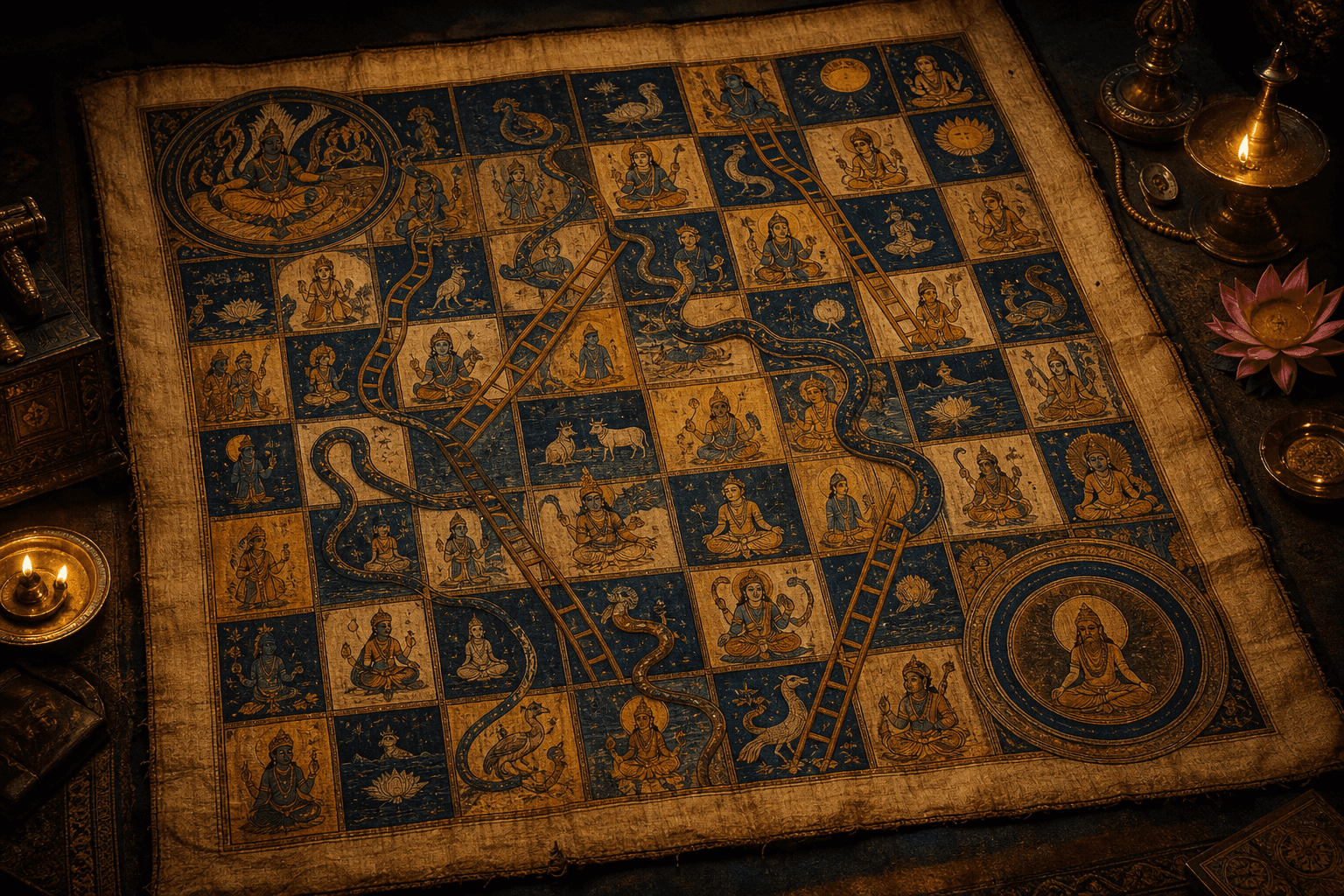
By most accounts, the ancestor of the game was played across the Indian subcontinent for centuries before any commercial version existed. It went by several names depending on the region and tradition — Gyan Chaupar ("the game of knowledge"), Moksha Patam (roughly "the ladder to liberation"), and in the Tamil south Paramapada Sopanam, the ladder to the supreme abode. The boards were not identical. Hindu, Jain, and later versions differed in their square counts and in exactly which square meant what. But the underlying logic was shared, and it was unmistakably a religious one.
Each square carried a name — a virtue, a vice, a plane of existence, a state of mind. A ladder rose from a virtue: an act of charity might lift you dozens of squares upward in a single move. A snake dropped from a vice: pride, lust, or anger would send you tumbling back down. The board was a map of the moral universe, and moving a token across it was a way of rehearsing the consequences of how you live. Scholars generally read these games as devices for teaching ethics and cosmology, especially to the young, in a culture that took karma and rebirth as the frame of a whole life.
The traditional attribution — that a particular saint or teacher "invented" the game — should be held loosely. No one can name a single author or a firm date with any confidence, and the honest position is that the game emerged and evolved over a long stretch, in more than one lineage at once. What is clear is the shape of the thing: a numbered grid where good qualities carry you up and bad ones pull you down, all of it pointed at a single destination square that stood for spiritual release.
What the board was actually saying
Leela, the version this app is built around, keeps that original grammar intact, which makes it a good place to see what the toy lost. Its 72 squares sit in eight rows of nine, and each row corresponds to a level of consciousness. You start at the bottom, at square 1 — Genesis, birth into the world — and the whole point is to reach square 68, Cosmic Consciousness, the state the tradition calls moksha.
The snakes and arrows are not random hazards. They are named, and they are consequences. On the Leela board, landing on Envy (square 12) drops you back to Avarice. Egoism (square 55), high up and close to the goal, plunges you all the way down to Anger near the start — a small parable about how self-importance can undo a lifetime of progress in one move. The arrows work the same way in reverse: Mercy (square 17) launches you almost to the top, and Purification carries you out of the lower rows up into the celestial planes. Even the last square before liberation is a warning — square 72 is Inertia, and its snake pulls you back to Earth, the tradition's way of saying that spiritual complacency at the very end is its own kind of fall.
Read that way, the board is not a race decided by luck. It is a claim about cause and effect: that qualities have gravity, that virtue lifts and vice drags, and that the outcome of a life is the sum of which squares you dwell on. The die does the rest of the work — it stands in for everything you don't control, the karma and chance that put you somewhere without your consent, leaving you to meet it with whatever freedom you have. That tension between the roll and your response is worth sitting with on its own, and we take it up in what the dice really mean.
How the meaning got stripped out
Here is the part that stings more than any snake. During the colonial period the game traveled from India to Britain, and in the late nineteenth century it was reissued commercially for a Western market as "Snakes and Ladders." The new versions kept the mechanic and quietly replaced the metaphysics. Some early English editions swapped Indian virtues and vices for their own moral vocabulary — obedience and thrift climbing, disobedience and idleness sliding — before even that thinned out. When the game later crossed to the United States and was sold as "Chutes and Ladders," the snakes themselves were judged too frightening for small children and replaced with playground slides. By then the destination square meant nothing at all. You just wanted to get to the last number first.
Nothing was technically broken. The board still worked; children still groaned when a friend hit a long snake. But a game that had been an argument about how to live became a game about who rolls better. The squares stopped having names. The goal stopped being liberation and became winning. That is the quiet loss at the center of the snakes and ladders origin story — not that the game was destroyed, but that it was emptied, then handed back to us as harmless.
Why does it matter? Because the original was doing something the modern toy cannot. It asked you to look at the square you landed on and recognize yourself in it — to notice that you have, in fact, been dragged down by your own envy, or lifted unexpectedly by an act of mercy you almost didn't perform. The meaning was the whole point. Restore it, and the same board that entertains a six-year-old becomes a mirror.
Playing it the old way
You don't need to relearn the game. You need to reattach the names. Roll, move, and then — before you rush to the next turn — read the square you are on and ask whether it describes something true about your life right now. A snake is not bad luck; it is an invitation to look at what pulls you down. A ladder is not a jackpot; it is a reminder of the quality that, when you actually practice it, lifts you faster than effort alone.
If you want the fuller history behind the names — how Gyan Chaupar and Moksha Patam differ, and what each square once meant — that companion piece goes deeper. If you are new to the tradition the whole board comes from, the introduction to Leela and the complete guide are the place to start.
The oldest version of this game was never meant to be won. It was meant to be understood. You can play the original 72-square board and see, square by named square, what the childhood toy left behind.