
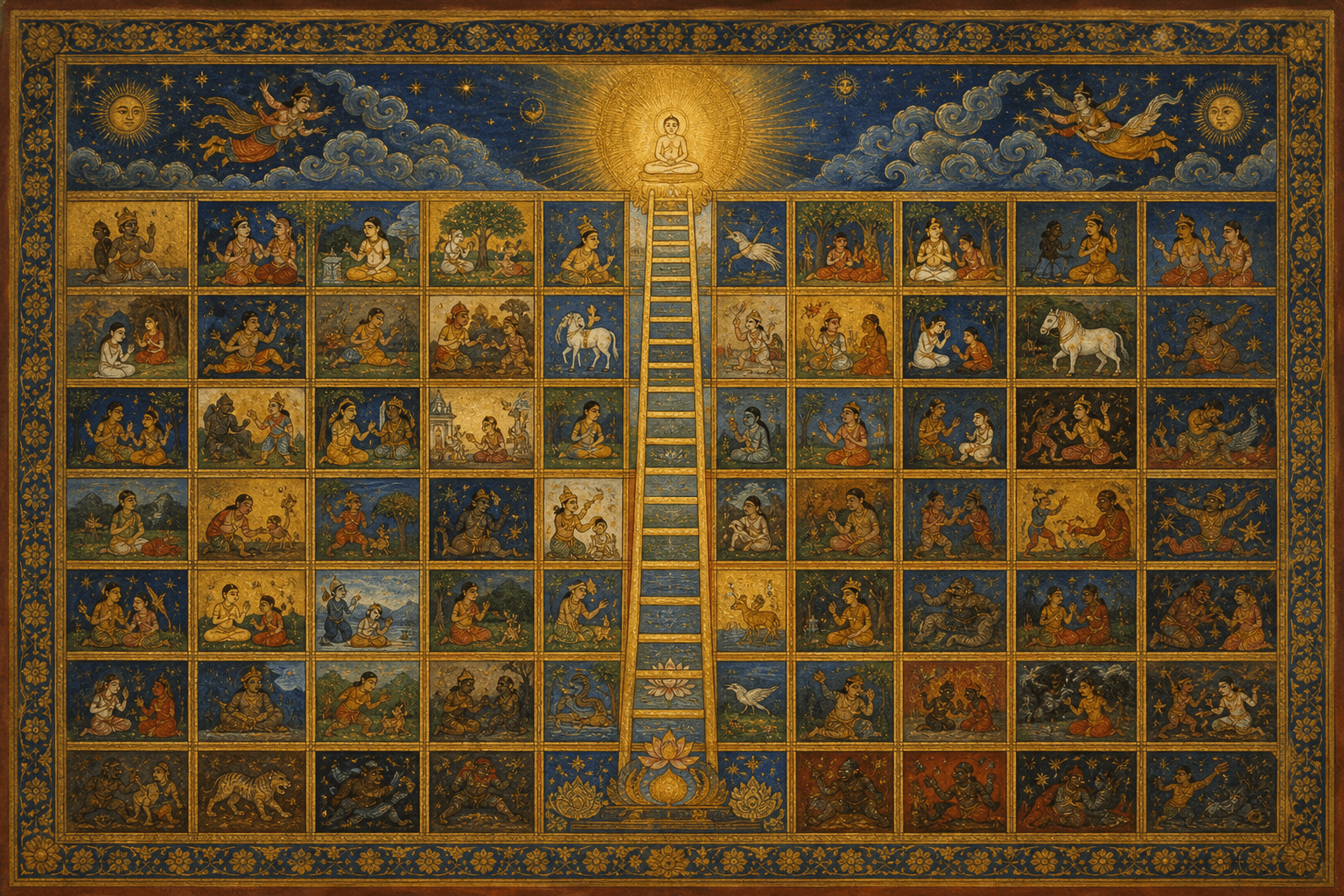
Gyan Chaupar and Moksha Patam: The Game's Forgotten Meaning
Look at an old hand-painted Indian board and something a modern Snakes and Ladders box has quietly erased jumps out at you: the squares have names. Not just numbers. One reads Anger, the next Greed, another Charity, and near the top, in gold, Cosmic Consciousness. This was never a race track. It was a chart of the inner life, and every square marked a condition a person could actually find themselves living in — a mood, a virtue, a plane of being.
That chart went by several names, and the names are the whole point. Strip them off and you get a children's game of luck. Keep them, and you get one of the oldest tools ever made for looking at your own life.
Three names, one idea
The board most people mean when they say "the original Snakes and Ladders" was known across India by different titles, depending on who was drawing it and why.
- Gyan Chaupar — literally the "game of knowledge." Gyan (from Sanskrit jñāna) is spiritual knowing; chaupar is the old dice-and-cloth game whose grid the board borrowed. So: knowledge played out on the chaupar cloth.
- Moksha Patam (also Mokshapat) — the "cloth" or "steps" to moksha, liberation. The name puts the destination in the title.
- Paramapada Sopanam — the "ladder to the supreme state," the term favored in the South.
Same object, three emphases: knowing, liberation, and the ladder you climb to reach it. What unites them is that the dice were never the story. In the tradition, a roll stands for karma — the momentum of past action — meeting the free will of how you respond. You don't control the number. You control what you make of where it lands. (We pull that thread apart in What the Dice Really Mean.)
Why the same board has so many faces
Here's the part the modern game hides completely: gyan chaupar was never a single fixed board. It was a format. Once you have a grid, named squares, downward snakes for what drags you back, and upward ladders for what lifts you, any tradition can pour its own cosmology into the cells — and several did.
By most accounts the game took shape in medieval India, and popular tradition attributes its moral form to poet-saints of that era, though the boards that actually survive are later paintings. What we can see clearly is the variety. Vaishnava artists drew Paramapada Sopanam — the ladder to Vishnu's supreme abode, Vaikuntha — a hundred-square climb of devotion, played through the all-night Vaikuntha Ekadasi vigil, where the goal square at the very top is union with the Lord beyond the river of death. Jain teachers drew Jñāna-bāzī, an eighty-four-square map of their own cosmos: the soul rising from the nigoda, the lowest flicker of life, up through the passions and the vows to mukti on the crystal roof of the universe. And within Islamic mysticism, Sufi masters adapted the same grid into a hundred-square "chess of the gnostics," a climb through the spiritual stations (maqamat) toward union with God.
Different vocabularies, one skeleton. A Jain, a Vaishnava, and a Sufi could sit at three visibly different boards and be doing recognizably the same thing: tracking the ascent of a soul, square by named square, with vices pulling down and virtues carrying up. (Each of those goal squares carries a different name for the same summit — we walk all of them in Nine Names for Enlightenment.)
Reading the named squares
Take the classic Vedic board, the 72-square version laid out in eight rows of nine. Read it from the bottom and the logic of the naming reveals itself. The lowest rows are dense with hazards: Illusion, Anger, Greed, Delusion, Conceit, Avarice — the coarse states that keep a person circling. These are where the snakes have their heads. Land on Egoism high up the board and a long snake drops you almost to the bottom, because pride, in this scheme, is the fall with the longest reach.
The ladders — drawn as arrows on many boards — sit on the virtues. Charity lifts you. Selfless Service lifts you further. Spiritual Devotion, near the top, throws a ladder straight to the goal. The moral arithmetic is blunt on purpose: generosity and service are shortcuts, and the ego is the trapdoor. You are meant to feel the geometry in your body when the dice send you sliding.
And the squares that aren't vices or virtues name the terrain between them — the Physical Plane, the Astral Plane, the Human Plane, the Plane of Austerity, the Plane of Reality. A player wasn't just advancing a token. They were being shown a whole cosmology of consciousness and asked, quietly, which of these am I standing in right now?
Liberation at the top
Every version of gyan chaupar points at one square, and everything below it is arranged to make that square mean something. On the Vedic board it is number 68, Cosmic Consciousness — Moksha — after which the final squares (69 through 72) fold back into the great qualities of nature, as if to say that even liberation returns to the play. On the Vaishnava board the summit is Vaikuntha; on the Jain board, the liberated siddha; on the Sufi board, union.
The design carries a teaching the numbers alone can't. You cannot earn the top square by sheer effort — the dice won't let you plan your way there. Nor is it pure luck — the ladders are real, and the choices that place you on them are yours. Liberation, on this board, is what happens when disciplined effort and grace happen to meet on the same roll. That tension between striving and surrender is the entire emotional engine of the game, and it's why people kept playing it as a contemplative practice rather than a pastime. (For the longer story of how this quiet devotional board became the plastic Snakes and Ladders on the shelf, see How Snakes and Ladders Began as a Spiritual Game.)
Playing it the way it was meant
The forgotten meaning isn't lost — it's just been painted over. Put the names back on the squares and the game does again what it always did: it hands you a mirror and a pair of dice, and it makes the abstract idea of a spiritual life concrete enough to move a token across. Where do you keep landing? Which snake keeps finding you? Which virtue, if you actually practiced it, would be your ladder?
If you're new to all of this, the Introduction to Leela is the gentlest doorway, and the full Complete Guide to Leela lays out the whole board square by square.
Better still, play it with the names intact. Roll the dice on the original board and watch your own patterns surface — the snakes you recognize, the ladders you've been ignoring, and the single lit square at the top that the whole thing has been pointing to all along.