
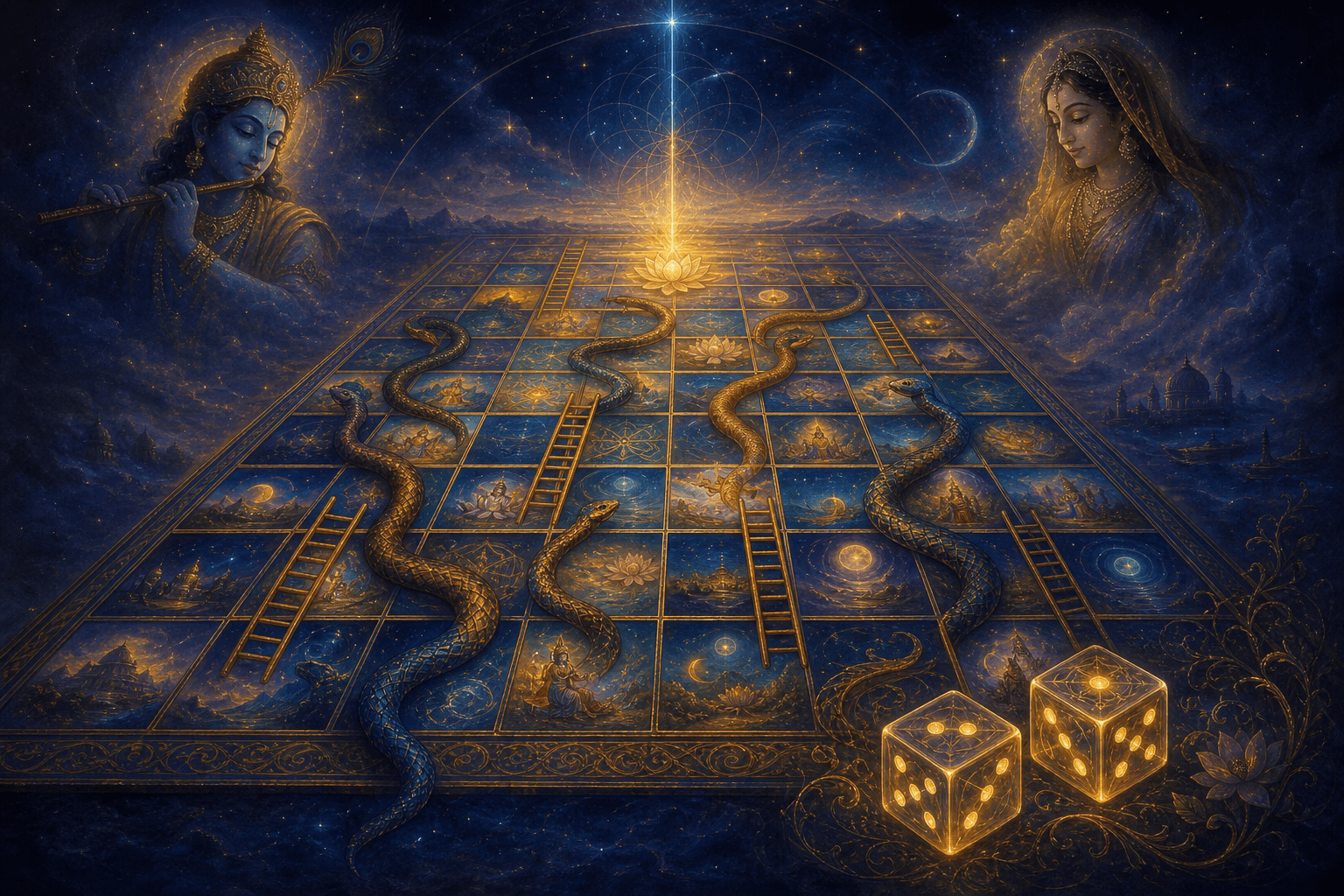
Leela: The Ancient Game of Self-Knowledge (A Complete Guide)
Roll a die, move your token, land on square 3 — Anger. A snake's mouth opens there and slides you back down the board. That single move is the whole idea in miniature: a board where your position is decided partly by the throw of a die and partly by which qualities of character you happen to land on. This is the Leela game, and long before anyone called it a children's pastime, it was a contemplative instrument for looking honestly at a life.
If you have ever played Snakes and Ladders, you have already played a hollowed-out version of Leela. The ladders were once virtues. The snakes were once vices. The finish line was liberation. This guide walks through what the original actually is, where it comes from, how the board is built, and — the part most people skip — how to play it as a mirror rather than a race.
What Leela actually is
Leela (लीला) is a Sanskrit word usually translated as "divine play" — the idea that existence itself is a kind of game the cosmos plays with itself. The board that carries the name is a spiritual map disguised as a game of chance. You begin at square 1, birth, and move by die roll toward square 68, Cosmic Consciousness, the state the tradition calls Moksha, or liberation. Along the way you pass through seventy-two squares, each one a named state of being: Illusion, Purification, Envy, Charity, True Awareness, Egotism, Bliss.
What makes it a game of self-knowledge rather than a lecture is that you don't choose your route. The die does. You land where karma and chance put you, and then the board asks a quiet question: what does it mean that I'm standing on Conceit right now? On Mercy? On Ignorance? The squares are not rewards or punishments so much as prompts. Leela externalizes your inner terrain onto a grid you can point at.
For a gentle first pass at the philosophy behind it, our introduction to Leela covers the same ground at a slower pace.
The ancestor of Snakes and Ladders
Here is a lineage most people never hear. The board game sold in every toy aisle as Snakes and Ladders — or Chutes and Ladders — descends, by most accounts, from this Indian original. Under its older names, Gyan Chaupar ("the game of knowledge"), Moksha Patam ("the ladder to liberation"), and Paramapada Sopanam ("the steps to the supreme abode"), it circulated across the Indian subcontinent for centuries as a teaching tool used across Hindu, Jain, and other traditions.
When the game traveled to Britain during the colonial era, its moral architecture was stripped out. The virtues and vices that named each square were erased, the ladders and snakes kept purely as mechanics, and the goal of spiritual liberation became a plain numbered finish. What survived is fun. What was lost is the reason the board was built. We trace that whole arc in how Snakes and Ladders began as a spiritual game and unpack the older names in Gyan Chaupar and Moksha Patam: the game's forgotten meaning.
None of this rests on a tidy origin story with a single inventor and a firm date, and you should be suspicious of anyone who gives you one. The honest version is that Leela is an old, widely-distributed tradition of pedagogical race-games, and Snakes and Ladders is its secularized descendant.
How the board is built
The Vedic Leela board is a grid of seventy-two squares, laid out in eight rows of nine. Read it from the bottom up, because that is the direction of ascent.
Each of the eight rows corresponds to a chakra — the ascending energy centers of the subtle body. The bottom row is Muladhara, the root: survival, grounding, the raw fact of having a body. Climb a row and you reach Svadhisthana, the seat of desire and creativity. Then Manipura, the solar plexus, where personal power and ego play out; Anahata, the heart, where balance is found; Vishuddha, the throat, where a person becomes truly themselves; Ajna, the third eye, the place of insight and penance; Sahasrara, the crown; and finally the cosmic plane beyond the seven, which reaches toward the goal at square 68 and the realms that surround it. The board is color-coded to match — red at the root, climbing through orange, yellow, green, blue, indigo, and violet toward white and gold at the summit. If you want to follow the chakra ladder square by square, beyond chakras: cosmic consciousness walks the final rows.
The design has a subtle logic. The lower rows are crowded with the traps of instinct and appetite; the upper rows thin out into subtler states. You are always, in effect, climbing out of the density of survival toward clarity — but the die keeps pulling you back into the body's concerns, which is exactly what a human life feels like.
Snakes and arrows: vices and virtues
Threaded across the grid are two kinds of connectors, and they are the heart of the mechanic.
Arrows — the ladders of the later game — ascend. Land on a virtue and it lifts you far up the board in a single move. Charity (square 20) carries you upward. Devotion, on square 54, launches you all the way to Cosmic Consciousness at 68. The arrows encode a genuinely hopeful claim: an act of real virtue can leapfrog you past dozens of squares of ordinary striving.
Snakes descend. Land on a vice and it drops you down, sometimes catastrophically. Egotism on square 55 — high on the board, near the crown — plunges you back to Anger on square 3, almost to the beginning. That placement is deliberate and a little brutal: spiritual pride is the vice that undoes the most advanced player, so the longest snake bites the one who has climbed the highest. Envy on square 12 slides you back to Avarice. Each snake is a specific way the self sabotages its own ascent.
Notice the asymmetry the board is teaching. Virtue lifts you, but a single lapse near the top can cost you everything you gained. The game is not moralizing at you; it is showing you a pattern you already know from your own life.
The die: karma meets free will
The most misread part of Leela is the die. A newcomer assumes it means the game is pure luck, and therefore meaningless. The tradition reads it the opposite way.
The throw is karma — the sum of causes you did not choose, arriving as this moment's circumstance. You do not control the number. What the die gives you is a situation; what you make of the square you land on is where something like freedom lives. Chance deals the hand, and your relationship to the hand is the practice. Sit with the tension between "I didn't choose this" and "this is still mine to respond to," and you have the entire Hindu meditation on karma and agency compressed into one roll. We give this its own treatment in what the dice really mean: karma, chance, and free will.
How to actually play it as a mirror
Playing Leela for self-reflection is simpler than it sounds and completely different from playing to win. There is no winning, really — there is noticing.
- Before you roll, hold a real question: a decision, a relationship, a stuck feeling. The board becomes a reading of that, not an abstract game.
- When you land on a square, stop. Read its name aloud. Ask, without forcing an answer: where is this alive in me right now? Landing on Illusion the same week you have been avoiding a hard truth is not a coincidence you should waste.
- Treat a snake as information, not a defeat. Which vice bit you, and where in your life does that same pattern pull you back down?
- Treat an arrow the same way. What virtue lifted you, and what would it cost to practice it on purpose?
That is the whole method: land, name, reflect, move. Do it slowly and a single game can surface more than an hour of trying to think your way through a problem. Our how-to-play guide has the full rules and a few reflection prompts to get started.
Where to start
Leela is one board with many faces. The Vedic original is where the tradition begins, and the most natural place to start is the Vedic board itself, whose goal square is Cosmic Consciousness at 68.
But the same architecture — ascent, snakes, arrows, a goal square — carries other maps of the self just as well. The app ships twelve other tradition boards alongside the Vedic one, each with its own summit: a Tibetan Buddhist board that climbs to Nirvana, a Sufi board whose hundred squares reach Union with God, a Taoist board that ends in harmony with the Tao, and psychological boards too. The Jungian path reframes the whole climb as individuation, ending not at Moksha but at the integrated Self. If the idea of many traditions pointing at one destination interests you, nine names for enlightenment walks the goal square of every board.
Whichever you choose, the invitation is the same one seekers have taken up for a very long time: sit down, hold a question, and let the game of self-knowledge show you where you actually are.
Ready to roll? Play a board now and let the die start the conversation.