
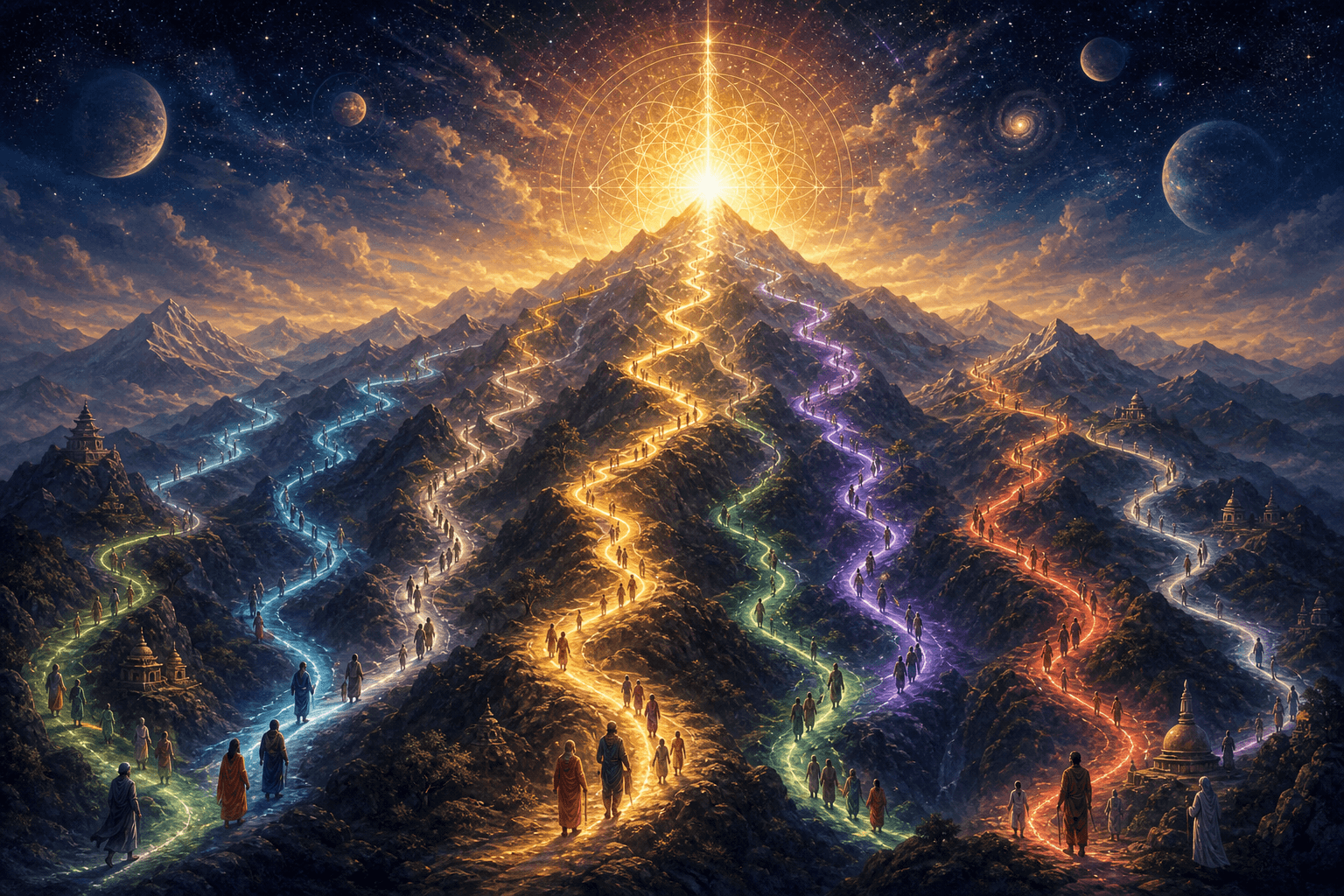
Nine Names for Enlightenment: Every Leela Board's Goal Square
Open thirteen Leela boards and go straight to the last square — the one no snake can pull you back from, the one every ladder was quietly pointing toward. On the Vedic board it is square 68, and its name is Cosmic Consciousness, Moksha. On the Tibetan board the climb runs higher, all the way to 104, and the name there is Nirvana. The Jain chart stops at 84 with Mukti; the Sufi board at 100 with Union. The same gesture repeats — a board that rises, a final square that ends the rising — and yet thirteen different words wait at the top.
That is the quiet argument this game keeps making about enlightenment across traditions: the summit sits in roughly the same place on every board, but it has never gone by one name. Lay the goal squares side by side and you can see, more clearly than any essay could tell you, both what the great paths agree on and where they genuinely part ways.
Every board is built to climb
Before the names diverge, notice how much the structure holds in common. Each board is a map of a life, or many lives, arranged so that you begin low and finish high. Snakes descend — the vices, the setbacks, the old habits that swallow hard-won ground. Arrows and ladders ascend — the virtues, the graces, the disciplines that lift you past where mere effort could reach. And a die decides how far you move, which is the game's honest way of admitting that no ascent is ever purely willed. Something meets your striving halfway: call it karma, call it chance, call it grace. (We pull that thread apart in What the Dice Really Mean.)
Leela is, by most accounts, the spiritual ancestor of Snakes and Ladders — the game we now hand to children was once a contemplative diagram known as Gyan Chaupar or Moksha Patam, and its ladders and serpents were moral instruction, not decoration. (That story is told in How Snakes and Ladders Began as a Spiritual Game.) What the thirteen boards inherit from that origin is a shared claim: the goal square is not a random finish line. It is the highest thing a tradition believes a person can reach, drawn as a place you arrive at by rising.
So the interesting question is not where the summit is. It is what each tradition says is standing there.
Union, release, or coming home
The goal squares fall, more or less, into three families — and the differences between them are real, not cosmetic.
The first family calls the summit union with a personal God, and it is careful to say that you do not stop being yourself when you get there. On the Christian board, square 68 is Theosis — the soul so wholly joined to God that His life becomes its life, and yet, as the square itself insists, "He remains God and you remain His creature." The Vaikuntapali board ends at Vaikuntha, Vishnu's supreme abode, a deathless realm of unbroken devotion where the freed soul serves the Lord forever rather than dissolving into Him. The Kabbalah board climbs the Tree of Life to Keter, union with Ein Sof, the Infinite — a drop returning to the ocean, its own words say, "distinct no more yet not destroyed." Even the Sufi board's summit, Union with God (Wasl), carries a warning the others lack: at the very last square lurks the ego's final snare, the temptation to mistake becoming one with God for becoming God. In this family, the self is fulfilled by love, not erased by it — and the boundary between creature and Creator is held on purpose.
The second family names the summit release — the end of the wheel of rebirth, not a wedding with a deity. The Tibetan board ends at Nirvana, the extinguishing, where the very forces that keep a self circling the six realms are cut off. The Jain board's square 84, Mukti, is starker still: the liberated soul rises to the Siddha-śilā, the crystal vault above the highest heaven, and rests there perfected, omniscient, and utterly alone — liberation as isolation, each soul a sun unto itself. Set that beside the Christian and Vaishnava summits and the contrast is sharp. One tradition's highest word is togetherness; another's is at last, apart from everything. It would be a mistake, and a disrespectful one, to blur them into the same feeling.
The Vedic summit sits between the families and leans toward a third note — coming home to what was always the case. Moksha, on that board, is less a destination reached than a veil dropped: cosmic consciousness recognized as the ground it never left. The Tao board says this most plainly. Its goal, Harmony with the Tao, greets you with the line "there was never any distance to cross." You do not conquer the Way; you stop resisting it, like a stream losing its name in the sea. Here the climb turns out to have been a kind of misunderstanding — necessary, but a misunderstanding — and the summit is the moment you see it.
The boards that keep the summit in this life
Five of the thirteen boards were built from psychology rather than scripture, and they make a quietly radical move: they refuse to put the goal in a metaphysical beyond. The summit is not somewhere you go when the world falls away. It is a way of being in the world, available now.
On the Jungian board, square 68 is the Self — Jung's symbol of wholeness, the marriage of conscious and unconscious, "the center and circumference of the whole psyche." You reach it not by leaving your shadow behind but by finally integrating it. (If that path draws you, start with The Jungian Path: Individuation as a Game.) The Maslow board tops out at Self-Transcendence, the need to go beyond the self that Maslow named late in his life, above self-actualization. The Erikson board ends at Integrity — an old person looking back on a whole life and being able to accept it, all of it, without despair. The Integrative board, drawn from parts work and nervous-system science, calls its summit Self-Leadership: the calm, compassionate core that can finally lead a healed inner system. And the Quantum board, the most experimental of them, borrows the language of physics to name its goal the Unified Field — coherence recovered, the separate forces folding back into the symmetry they only appeared to leave.
These summits share a spine with the religious ones: the separate, defended ego is again what has to soften. But their promise is different. You are not asked to escape the world. You are asked to stand in it more whole. That is a genuinely distinct vision of the good, and it deserves to be counted as its own answer rather than filed under the older ones.
So which name is yours
Here is what the side-by-side view actually offers, and it is not a tidy synthesis. The thirteen boards do not quietly agree that the summit is "all the same thing." They agree that there is a summit, that it lies at the far end of a real ascent, and that the small, grasping self is what must be transformed to reach it. After that, they diverge — into union that keeps you a self, release that dissolves the self, isolation that perfects the self, and wholeness that finally lets the self be at home. Those are not four ways of saying one word. They are four different words, and the honest thing is to let them stay four.
Which makes the game a strangely good instrument for self-knowledge. When you read the thirteen goal squares, one of them tends to land harder than the rest — the word that names what you are actually reaching for, whether you had language for it or not. That recognition is worth more than any argument about which tradition is right.
A small practice: read the summit names slowly — Moksha, Nirvana, Mukti, Theosis, Wasl, Keter, Vaikuntha, Harmony, the Self, Self-Transcendence, Integrity, Self-Leadership, the Unified Field. Notice which one your attention snags on. Then notice which one you flinch from. Both are telling you something. The word you long for names your hope; the word you resist often names the very thing standing between you and it.
Then go find out by climbing. Pick the board whose summit named your longing, and play a round — roll the die, take the ladders, survive the snakes, and see what the last square feels like when you finally land on it. If you want the fuller map of how Leela works before you begin, the complete guide to the game of self-knowledge lays it all out, and the introduction to Leela is the shortest way in.