
 Human Quest · Personal growthLog in

The 7 Chakras, Explained (and How to Read Them as Life-Stages)
Look at the Vedic Leela board and you are looking at the chakra system laid flat. Seventy-two squares, eight rows of nine, and each of the first seven rows is a chakra band — with a marker square sitting dead-center in each: Physical Plane at 5, Astral Plane at 14, Celestial Plane at 23, Plane of Balance at 32, Human Plane at 41, Plane of Austerity at 50, Plane of Reality at 59. The eighth row, squares 64 through 72, is deliberately past the chakras — the territory the map calls cosmic. This is the clearest reason to have the 7 chakras explained not as a stack of spinning wheels but as a route you actually travel.
Most diagrams show the chakras as a column of colored discs running up the spine, which is fine as far as it goes but tells you almost nothing about how to use them. The board does something more useful. It turns each center into a stage — a set of squares you land on, get stuck in, climb out of. Read that way, the chakras stop being anatomy and start being biography.
One honest note before we climb. Chakra language is a symbolic map, not a medical claim. Nobody has found these centers under a scalpel, and "blocked throat chakra" is not a diagnosis. What the model is good at is naming clusters of experience — the difference between feeling unsafe and feeling unheard, between craving and calm — and giving them a location you can point to. Take it as a language for inner states, not physiology, and it earns its keep.
Muladhara — the ground you stand on
The root chakra, Muladhara ("root support"), sits at the base of the spine. Its concern is the oldest one you have: am I safe, am I fed, do I belong to the earth at all. On the board this is the whole first row, presided over by the Physical Plane at square 5 — the world of names, forms, and bodies.
Read as a life-stage, this is infancy and every adult moment that drops you back into pure survival. Open, it feels like being able to rest in your own body, pay the rent without panic, trust the floor. Blocked, it shows up as chronic low-grade fear, hoarding, restlessness that no amount of reassurance settles. The board is blunt about the traps here: the row runs straight through Anger, Greed, Delusion. Those are not moral failings so much as what a threatened animal does. The first chakra post walks the whole row square by square.
Svadhisthana — desire and the inner theater
Move up to the sacrum and you reach Svadhisthana, the sacral chakra, seat of pleasure, sexuality, and imagination. The board's second row is governed by the Astral Plane at 14 and threaded with the Plane of Fantasy at 15 — the realm where feeling and daydream color everything you see.
As a stage, this is the child who discovers wanting, and the adult who has to decide what to do with appetite. An open sacral center is fluid: you can enjoy without clutching, create without needing the result to be perfect. Blocked, it swings between numbness and compulsion — either nothing moves you, or you chase the next hit of sensation to feel alive. Because this row lives so much in fantasy, its particular danger is mistaking the daydream for the plan. The second chakra post sits with that realm of fantasy in detail.
Manipura — power, will, and consequence
At the navel is Manipura, the solar-plexus chakra, and its subject is power — the will to act and the courage to own what your actions cause. The third row centers on the Celestial Plane at 23 but its real engine is square 19, the Plane of Action: the stage on which karma is made.
This is the chakra of the striving adult, the one who wants to matter and to leave a mark. Healthy, it reads as steady confidence — you decide, you follow through, you can be told no without collapsing. Distorted, it goes one of two ways: domineering and controlling, or deflated and unable to assert anything at all. The board treats this row as a courtroom, with squares like Atonement and Selfless Service marking how you settle the debts your power runs up. If you want the mechanic behind that — the die roll as karma meeting free will — the theater of karma covers it, and what the dice mean unpacks the chance-and-choice question directly.
Anahata — the turn toward the heart
Anahata, the heart chakra, sits at the center of the chest, and it is the hinge of the whole system: three centers below it are concerned with self, three above with something larger, and the heart is where the two meet. The board makes this literal — the fourth row is watched over by the Plane of Balance at square 32, equilibrium between opposing forces.
The life-stage here is the one where you stop asking only "what do I want" and start asking "what does love require." Open, the heart is generous without keeping score, able to grieve and still stay soft. Blocked, it hardens into resentment, or over-gives until there is nothing left and calls that virtue. Balance is the exact word for the work: not endless self-sacrifice, not armored self-protection, but a steady middle. The fourth chakra post stays with that theme of attaining balance.
Vishuddha — becoming who you are
At the throat is Vishuddha, the center of expression and truth. Its question is whether the person the world sees is the person you actually are. The fifth row runs up to the Human Plane at square 41 — the plane the tradition reserves for self-reflective consciousness, the creature that can look at itself and choose.
This is the stage of coming into your own voice. It is why the classic reading of this row is man becomes himself. Open, you say the true thing even when it costs something, and your outside matches your inside. Blocked, the throat closes: you swallow what you mean, perform a self that isn't yours, or overtalk to fill a silence you can't tolerate. The row also holds Ignorance and Right Knowledge back to back — a reminder that honest speech depends first on honest seeing. The fifth chakra post follows that arc.
Ajna — insight and the cost of seeing
Ajna, the third-eye chakra, sits between the brows and governs intuition, discernment, and the kind of knowing that arrives without argument. The sixth row climbs to the Plane of Austerity at square 50 — tapas, the heat of concentrated practice — which tells you something. Clear inner sight is not a gift that lands; it is disciplined.
As a stage, this is the seasoned adult who begins to trust the quiet signal over the loud one, and who has done enough inner work to tell the two apart. Open, discernment feels effortless and calm. Blocked, it splits into extremes: either you dismiss intuition entirely and live only by the checklist, or you float off into every vision and omen without grounding. The board's word for the discipline that steadies this center is austerity, which is why the classic reading calls it a time of penance. The sixth chakra post explores that.
Sahasrara — the plane of reality
At the crown is Sahasrara, the thousand-petaled lotus, the center associated with transcendence and union. The seventh row rises to the Plane of Reality at square 59 — satya-loka, truth beyond appearances — and this is as high as the chakra ladder itself goes.
The stage here is late and rare: the point where the separate self loosens its grip and you glimpse being part of something you did not author. Open, it reads as peace that doesn't depend on circumstances, meaning that doesn't need defending. Its distortions are subtle — spiritual bypassing, using "oneness" to avoid the unglamorous work of the lower rows, mistaking a good mood for enlightenment. The seventh chakra post sits with the plane of reality.
The eighth row — off the chakra map
Here is where the board says something the standard seven-chakra chart doesn't. There is a whole row above the crown: squares 64 through 72, beyond the chakras entirely. This is where the goal lives — square 68, Cosmic Consciousness, the win condition of the entire game. The three gunas close the board out: True Nature (70), Activity (71), Inertia (72). The point being made is quiet but real: the chakras get you to the top of the human ladder, and then there is further to go. The beyond-chakras post maps that final row.
Reading the seven as one journey
Set out flat, the sequence tells a coherent story. First you have to survive and belong (root). Then you learn to want and imagine (sacral). Then you act and answer for it (solar plexus). At the heart you turn from self toward love, and everything above the heart is some form of coming true — speaking honestly, seeing clearly, letting the small self dissolve. It is less a stack of energy centers than the shape of a life, which is exactly why Leela is so often called the game of self-knowledge — and why it is widely regarded as the spiritual ancestor of Snakes and Ladders, back when the snakes were vices and the ladders were virtues.
You will not experience these as tidy levels. Most of us are open in one center and jammed in another, secure at the root and mute at the throat, or eloquent but heart-guarded. That is normal, and it is where the practical work starts. If you already have a hunch about which center is loudest right now, which chakra needs your attention is a written self-assessment worth an honest ten minutes; if you want the concrete signals and small practices per center, chakra imbalance: signs and practices lays them out one center at a time.
The fastest way to feel the difference, though, is to walk the rows yourself. Play the Vedic board, watch which squares you land on and which ones you keep circling back to, and read the chakras the way the board intends — as stages of a journey you are already in the middle of.
Keep reading
The Snakes of the Self: Inflation, Projection, and Possession
How the Jungian board reads psychological inflation, projection, and possession as the snakes that undo individuation — and how to climb back.

Nine Names for Enlightenment: Every Leela Board's Goal Square
A look at enlightenment across traditions through the goal square of all thirteen Leela boards — union, release, and wholeness under thirteen different names.

What the Dice Really Mean: Karma, Chance, and Free Will
A single die decides where you land in Leela, but not what you do there — a reflection on karma and free will, and living well with chance.
Gyan Chaupar and Moksha Patam: The Game's Forgotten Meaning
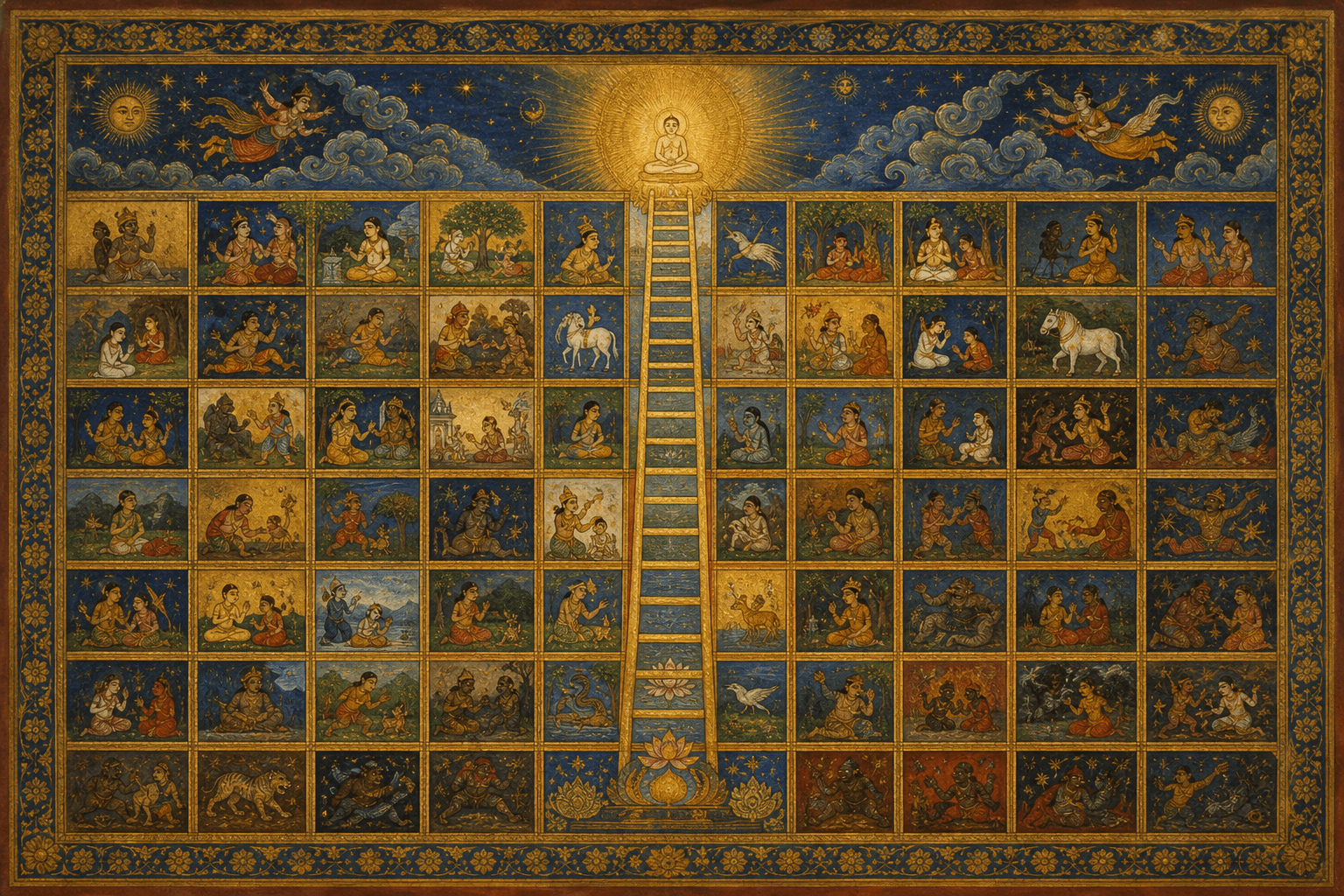
What Gyan Chaupar and Moksha Patam actually mean — the named squares, the traditions that drew their own boards, and liberation at the top.
How Snakes and Ladders Began as a Spiritual Game
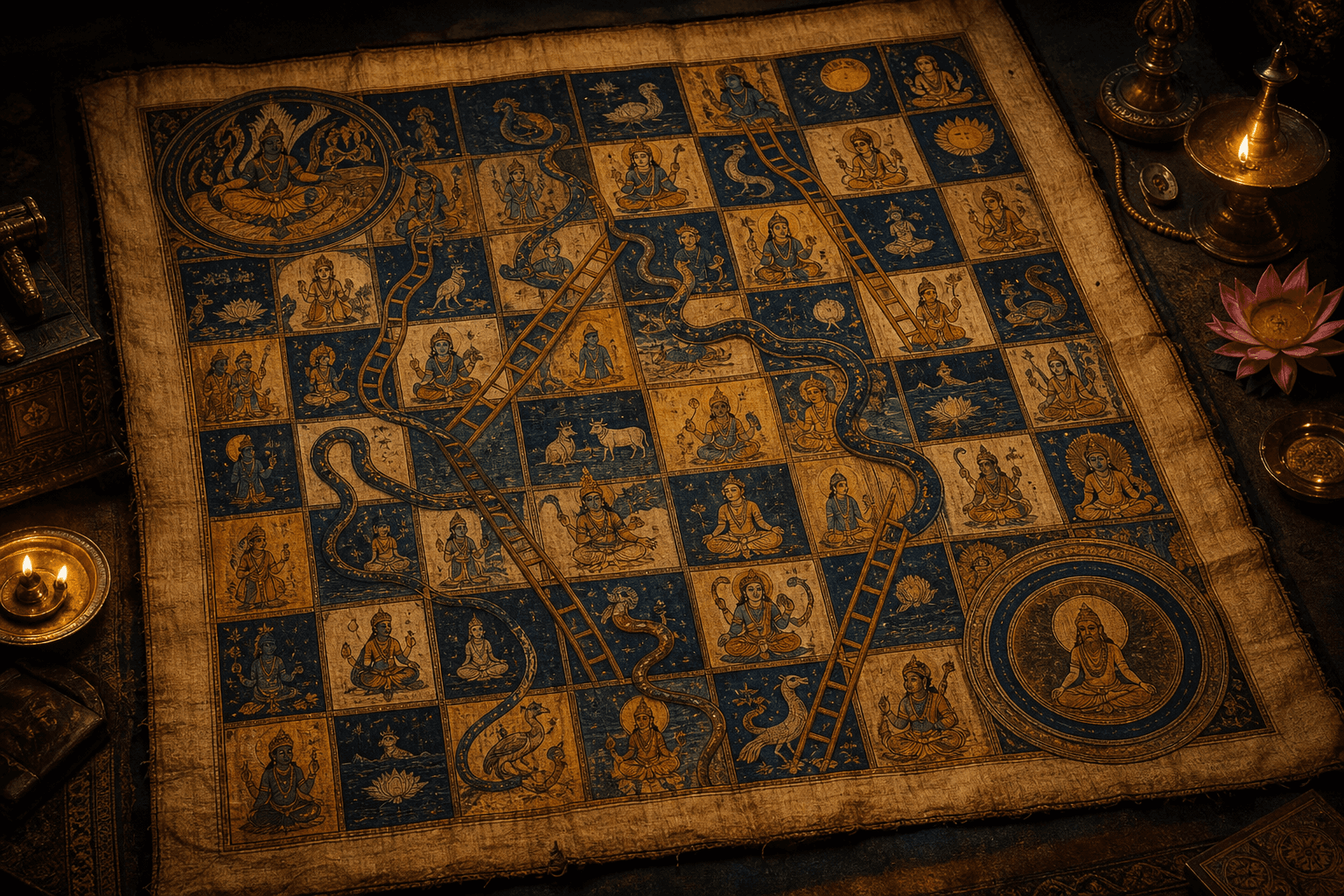
The snakes and ladders origin isn't a children's toy — it's an Indian game of moral instruction where ladders were virtues and snakes were vices.
Leela: The Ancient Game of Self-Knowledge (A Complete Guide)
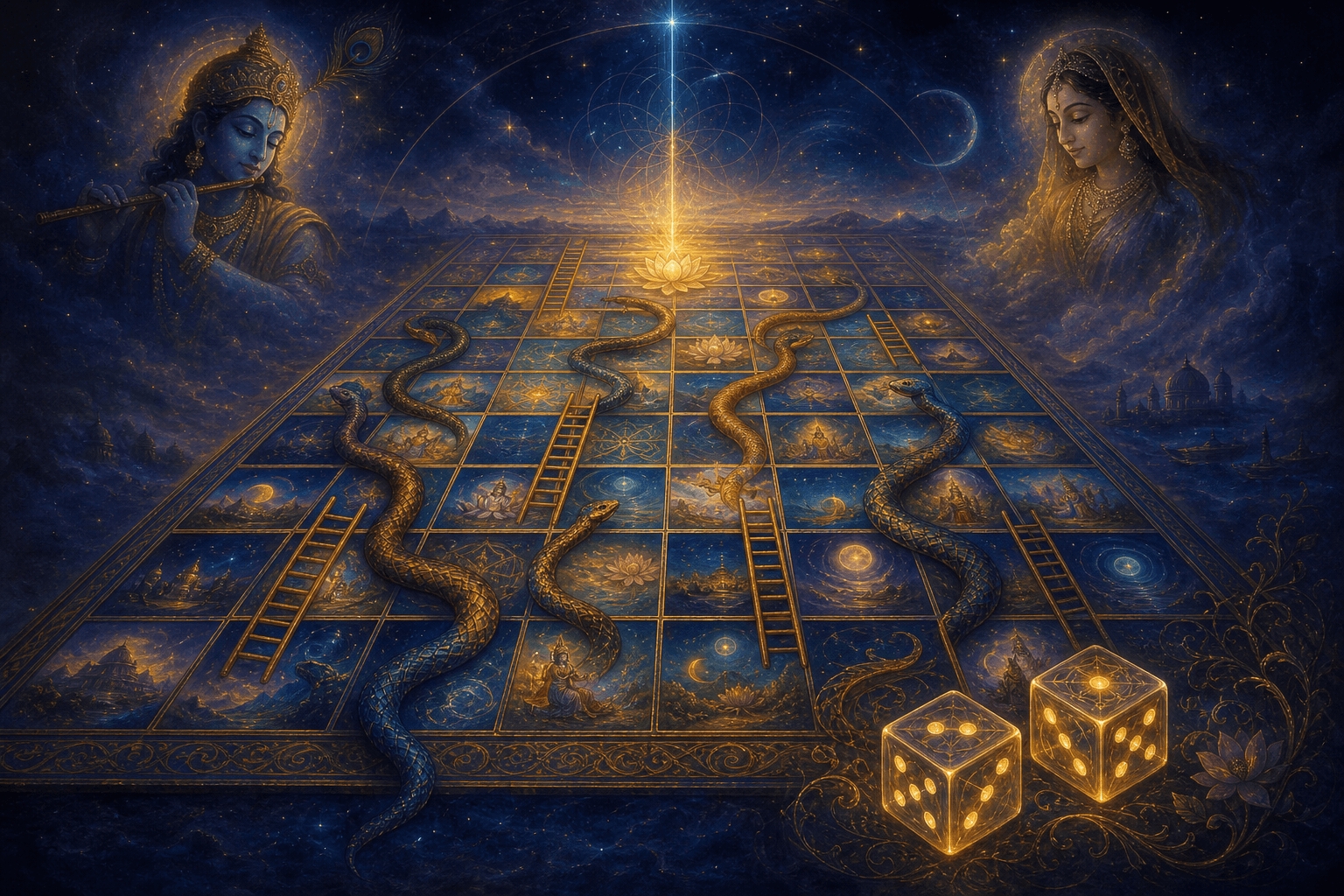
The Leela game is the ancient spiritual ancestor of Snakes and Ladders: 72 squares, eight chakra rows, and a die that turns play into self-reflection.